
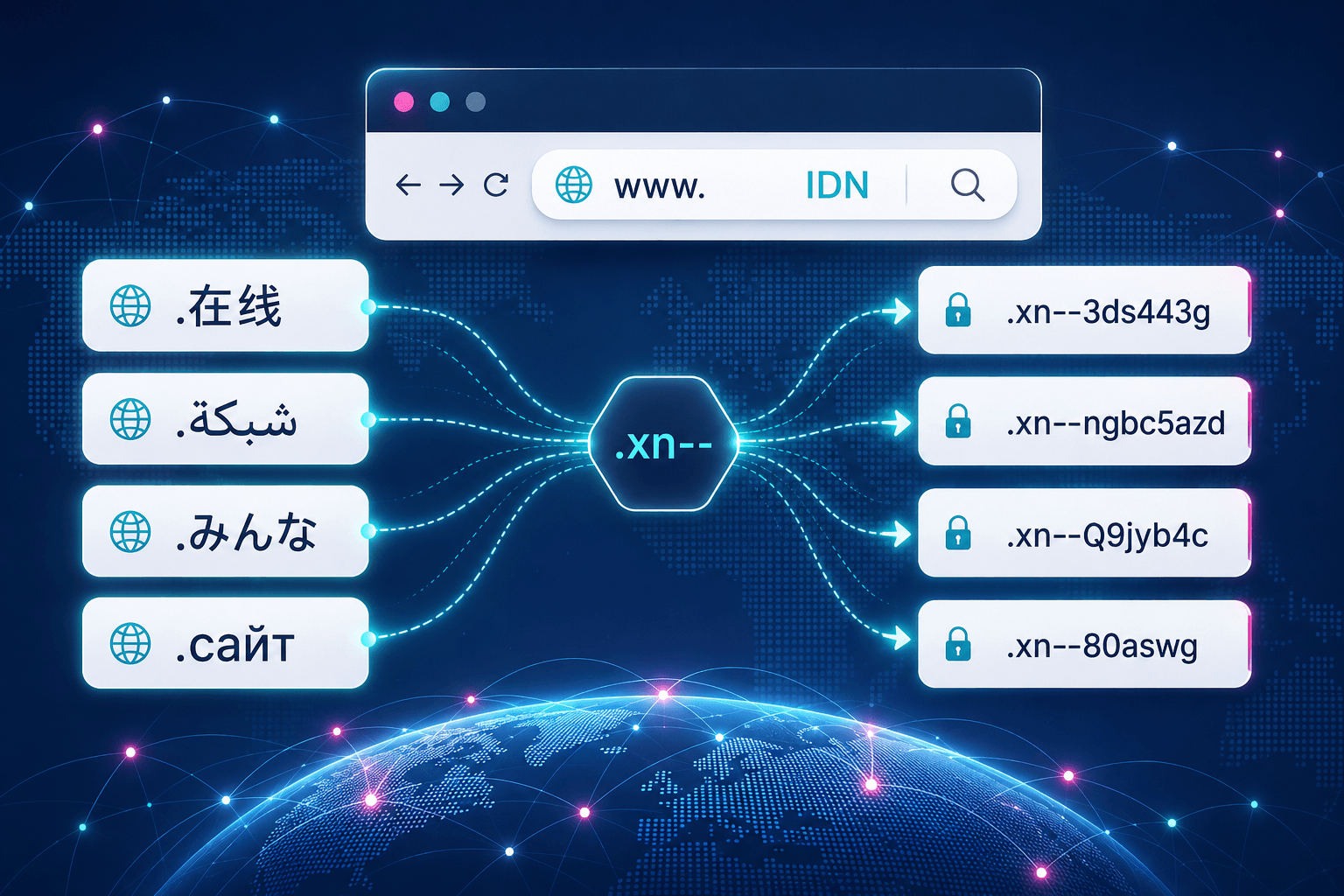
Most people are familiar with domain extensions such as .com, .net, .org, .co.za, or .na. But sometimes, when browsing a domain price list, you may see extensions that look much more technical, such as .xn--3ds443g, .xn--ngbc5azd, or .xn--q9jyb4c.
At first glance, these look like random strings. In reality, they are not random at all. They are the technical ASCII versions of internationalized domain extensions — domain extensions written in non-Latin scripts such as Chinese, Arabic, Cyrillic, or Japanese.
These are known as Internationalized Domain Names, or IDNs.
What does .xn-- mean?
The .xn-- prefix tells us that the domain extension has been encoded using a system called Punycode.
The Domain Name System was originally built around a limited set of ASCII characters: the letters a to z, the numbers 0 to 9, and the hyphen -. That works well for English-language domains, but it does not directly support scripts such as Chinese, Arabic, Japanese, or Cyrillic.
To solve this, internationalized domains have two forms:
- The user-friendly form, written in the native script, such as .在线
- The technical ASCII form, used by DNS systems, such as .xn--3ds443g
These two versions refer to the same domain extension. The .xn-- version is simply the encoded technical version that computers and DNS infrastructure can process reliably.
So when you see .xn--3ds443g, it is not a separate “mystery” extension. It is the encoded version of .在线, which is a Chinese domain extension meaning online.
ASCII form vs native-script form
A useful way to think about it is this:
| Type | Example | Purpose |
|---|---|---|
| Native-script form | .在线 | What users are meant to see and recognize |
| ASCII / Punycode form | .xn--3ds443g | What DNS systems can process technically |
In domain terminology, the native-script version is often called the U-label, while the ASCII/Punycode version is called the A-label.
For example, a domain such as:
example.在线
may also be represented technically as:
example.xn--3ds443g
Both point to the same domain extension. One is human-friendly; the other is machine-friendly.
Why do these domains exist?
Internationalized domain names make the internet more accessible to users who read and write in languages that do not use the Latin alphabet.
Instead of forcing everyone to use English-style extensions, IDNs allow domain names to be written in scripts that are familiar to local users.
This can be useful for:
- businesses targeting Chinese, Japanese, Arabic, or Russian-speaking audiences;
- brands that want a more localized online presence;
- organizations that operate in multilingual markets;
- companies that want to protect their brand in multiple scripts;
- websites where trust and readability in the user’s own language matter.
Examples of .xn-- domain extensions available through Namhost
The table below shows several internationalized domain extensions available through Namhost. The ASCII / Punycode extension is the technical version, while the native-script extension is the symbol or script that users would normally recognize.
| ASCII / Punycode extension | Native-script extension | Language / script | English meaning | Price |
|---|---|---|---|---|
| .xn--3ds443g | .在线 | Chinese, Simplified | Online | R 550.00 |
| .xn--6frz82g | .移动 | Chinese, Simplified | Mobile | R 530.00 |
| .xn--80asehdb | .онлайн | Cyrillic / Russian | Online | R 905.00 |
| .xn--80aswg | .сайт | Cyrillic / Russian | Site / website | R 905.00 |
| .xn--c1avg | .орг | Cyrillic / Russian | Org / organization | R 350.00 |
| .xn--czrs0t | .商店 | Chinese, Simplified | Shop / store | R 1 225.00 |
| .xn--fiq228c5hs | .中文网 | Chinese, Simplified | Chinese website / Chinese web | R 10 230.00 |
| .xn--fjq720a | .娱乐 | Chinese, Simplified | Entertainment | R 2 525.00 |
| .xn--ngbc5azd | .شبكة | Arabic | Network / web | R 400.00 |
| .xn--nqv7f | .机构 | Chinese, Simplified | Organization / institution | R 350.00 |
| .xn--q9jyb4c | .みんな | Japanese | Everyone | R 335.00 |
| .xn--tckwe | .コム | Japanese Katakana | Com | R 320.00 |
| .xn--unup4y | .游戏 | Chinese, Simplified | Games | R 2 525.00 |
| .xn--vhquv | .企业 | Chinese, Simplified | Enterprise / business | R 2 525.00 |
Are these country-specific domains?
Not necessarily.
Some people assume that a Chinese, Arabic, Japanese, or Cyrillic domain extension must belong to a specific country. That is not always correct.
Many of these are generic top-level domains, or gTLDs. That means they are not the same as country-code domains such as .na, .za, .uk, or .de.
Instead, they are aimed at users of a particular language, script, or market.
For example:
- .在线 is written in Chinese and means “online”.
- .شبكة is written in Arabic and means “network” or “web”.
- .みんな is Japanese and means “everyone”.
- .сайт is written in Cyrillic and means “site”.
These extensions are about language and script first — not necessarily about one specific country.
Why might a business register an internationalized domain?
A business may register an IDN domain for several reasons.
The first is localization. A domain in a customer’s own language or script may be easier to read, remember, and trust.
The second is brand protection. If your brand operates internationally, you may want to prevent other parties from registering similar names under internationalized extensions.
The third is market relevance. If you are targeting Chinese-speaking, Japanese-speaking, Arabic-speaking, or Russian-speaking users, an IDN extension can make your online presence feel more native to that audience.
The fourth is availability. In some cases, a strong name may already be taken under .com, but may still be available under a more targeted internationalized extension.
A note about browser display
Modern browsers usually show the native-script version of an internationalized domain when it is safe to do so. In some cases, however, a browser may show the .xn-- version instead.
This can happen for compatibility or security reasons.
For example, internationalized characters can sometimes look visually similar to Latin letters. This has created risks around lookalike or phishing domains. Because of that, browsers and registries apply rules around how these domains are displayed and registered.
For ordinary users, the important point is simple: the .xn-- form is the technical version, while the native-script form is the readable version.
Final thoughts
.xn-- domain extensions may look complicated at first, but they are simply the encoded form of internationalized domain names.
They allow the internet to support domain extensions in scripts such as Chinese, Arabic, Japanese, and Cyrillic, while still remaining compatible with the underlying DNS infrastructure.
For businesses, these domains can be useful when targeting specific language communities, localizing a brand, or protecting a name internationally.
If you see a .xn-- extension in a Namhost domain search or price list, it is worth checking what the native-script version means. In many cases, it may be a highly relevant extension for a specific market, language, or audience.